Silvia Napoli on Medea Material, “il manifesto”, November 1 2025
When sound is everything, or almost everything. Reviews, visions, programming comparisons
Silvia Napoli, “il manifesto”, November 1st 2025
https://www.ilmanifestoinrete.it/2025/11/01/quando-il-suono-e-tutto-o-quasi/
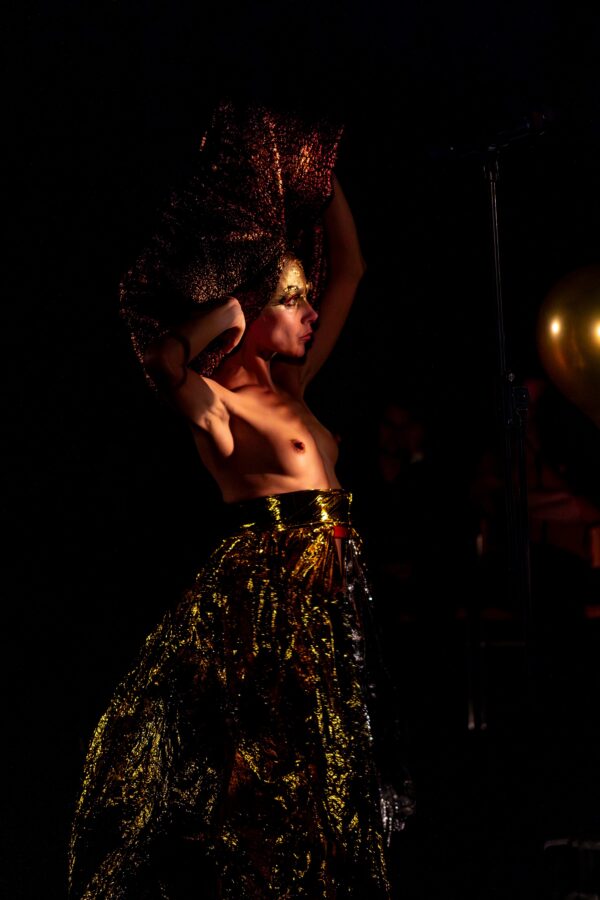
“[…] Tomšič’s Medea is female and imperious, perhaps wounded but not tamed or satisfied, the bearer of an irreducible otherness, an almost species-like diversity, as if all Mediterranean archetypes had been scanned by Donna Haraway and projected into a remote future, where there are also those who do not accept it, who rebel against dynastic entanglements and diplomatic accommodations and denounce oppression. Not a devoted, wounded wife then, but a cultural virus irremediably inoculated into the dominant patriarchal society and destined to forever contaminate a genealogy that we know is doomed to ruin. What the Fates prepare is not a blind, deceitful destiny, but only the result of a well-chosen kairos, calculated with all its responsibilities, carefully weighed against the alternatives. In short, it is not heart-wrenching and hesitant despair, but the lucidity of the kamikaze who prepares the attack, the terrorist infiltrated from abroad, seductive like Mata Hari, in the rich, allusive stage costumes that adorn and make the insolent and sculptural nudity of our protagonist unattainable. A queen who glares with scorn, with contempt for her antagonist on the Balkan route of prostitution, but who is always as untouchable as a priestess, like someone on a mission, and even wearing translucent, vertiginous boots.
It is interesting because, going far beyond the cold and didactic standards to which she had accustomed us, Tomšič performs an alchemical act here, combining ice and fire as the constituents of a single personality, even in a game of splits, alchemy like a philosopher’s stone, to which all the sinister flashes of gold allude until the end. Gold notoriously expresses royalty, of course, but also mending, and in fact this is the interpretation: justice, the mending of wrongs, is carried out according to the criteria of the very society that would like to exile and corner you. The transformations in the performance are achieved through Tomšič’s own movements, almost choreographed, and above all through surprising work on sound and voice that leaves the audience amazed. The text, the words, are among the last elements to arrive, and long before the political presence of the body, comes the sneering voice, the undefinable howl. Technical expedients and current sound design technologies play a part, but only to a certain extent, with a great deal of disciplined and sacrificial study and expansion of her vocal abilities, which take into account Demetrio Stratos and Diamanda Galas as guardian deities. […]”