Anna Cavallo on Medea Material, “Pagina Tre”, October 11 2025
Medea, patriarchy and colonization
Anna Cavallo, “Pagina Tre”, October 11th 2025
https://paginatre.it/medea-patriarcato-e-colonizzazione/
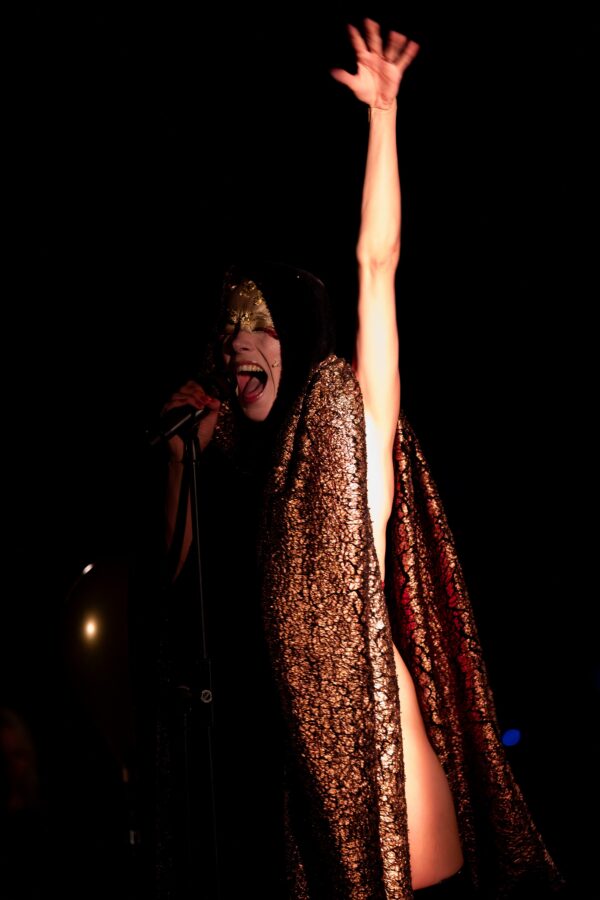
“[…] In an intimate and evocative stage setting, where the lighting is meticulously calibrated, giving the audience a voyeuristic perspective on the drama unfolding before their eyes, Agata-Medea, a slight and sinuous figure wrapped in a cloak, curses, swears, hates, and kills.
A desperate and ferocious character that Müller transfers to the contemporary historical plane. The story of Medea becomes a metaphor for the colonizing and exploitative West. Characterized by the same specious civilizing impulses that the German playwright recognizes in the Greeks towards the barbarian peoples of Colchis.
At a certain point, Medea slowly strips naked and begins to spin around, projecting a tiny light onto each spectator, who, in this shift in perspective, becomes jointly responsible for the tragedy unfolding. No longer flesh but voice, she chronicles the desolate post-atomic landscape of the West.
Medea embodies many female archetypes: queen, wife, lover, mother, murderer, but also foreigner, outcast, exploited for political purposes. What approach did you use to interpret her through Heiner Müller’s filter?
A.T.: I chose to work on this text by Heiner Müller because I fell in love with the radicality and the sonic and poetic power of his words, at a time when I was reading various female authors in search of a strong female figure to whom I could dedicate my first solo direction. His Medea is extremely violent, radical, atrocious, human, and divine at the same time. For me, having spent over 13 years researching the voice and musicality of words, coming across Heiner Müller was quite a natural event, also considering his strong connection with Bertolt Brecht and 20th-century political theater. Both are fundamental elements of my artistic journey, which have allowed me to approach the myth of Medea without distancing myself from the aesthetics and content that have characterized my previous work with ErosAntEros over the last 15 years.
What does the character of Medea tell us about women’s relationship with power and disobedience?
A.T.: Medea is a very young woman who opposes the established patriarchal power several times throughout her story, in the various versions of the myth (where, incidentally, she does not always kill her children). She does so first by renouncing her father’s law, helping the foreign occupier, Jason, to seize the Golden Fleece and sacrificing her own brother in the escape to do so. In this sense, she renounces her offspring, but also her fatherland (the etymological origin of this word is not accidental!).
She does so a second time after being betrayed by Jason, repudiating her role as a caring mother (towards her children) and wife who obeys her husband and then steps aside when she is no longer desired.
Medea places herself above the laws that society imposes on her as a woman, daughter, and mother: this is what makes her an extremely powerful myth, rewritten more than 2000 times from antiquity to the present day, which still speaks strongly to our present. Not to mention Medea’s dimension as a barbarian, a foreigner, a migrant, to be civilized by Jason, the exporter of Greek democracy, which is even more fiercely relevant today. […]”