Medea Material on “Il Corriere della Calabria”, October 13 2025
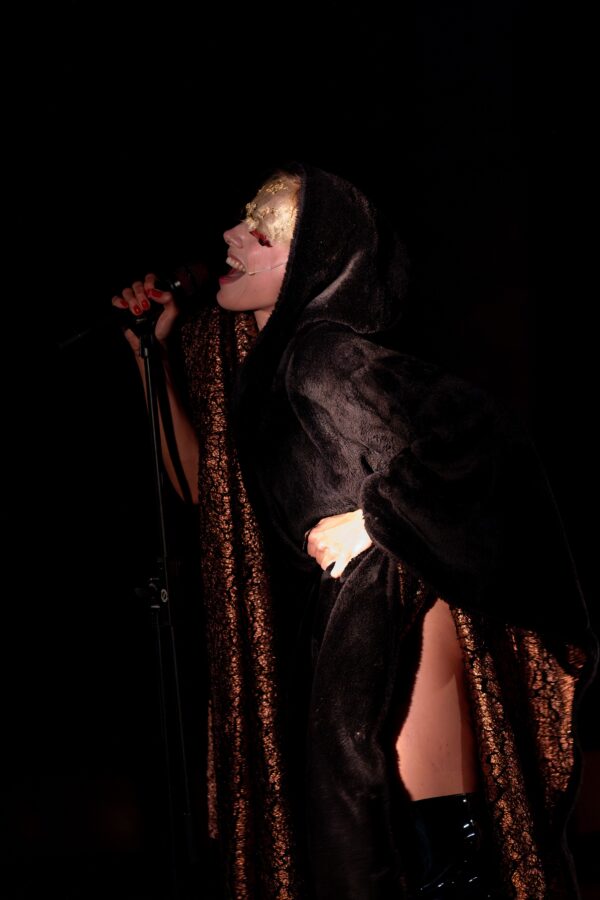
At Festival d’Autunno the Medea by Agata Tomšič for the national premiere at Museo Marca in Catanzaro
“Il Corriere della Calabria”, October 13th 2025
https://www.corrieredellacalabria.it/2025/10/13/al-festival-dautunno-la-medea-di-agata-tomsic-in-prima-nazionale-al-marca-di-catanzaro/
“Cruel, ruthless, and desperate; mother, lover, murderer, and slave, body and passion, rage and pain: in 50 minutes Agata Tomšič sublimates, in her Medea, every aspect of her powerful and controversial character. And she does so, in its National Premiere, for Festival d’Autunno, through those “new languages” that the Festival chose to express this year to also speak to a different audience and pursue the intent of wanting to combine tradition – in this case the myth – with contemporaneity.
The spaces chosen by the Festival Director, Antonietta Santacroce, are perfectly suited to the performance: the MARCA Museum in Catanzaro offers the ideal spatial dimensions for the staging. In a large room, bare of any other object, the darkness swallows the spectators seated in a circle around a pulpit and leads them into an essential and existential dimension, in which space is rarefied, smoke pervades the environment from below, and a thin line of light cuts it in two (the light design, so essential yet expressive, is by Gianni Gamberini). That darkness, Agata Tomšič will explain later, is “the exposure of one’s own inside to the outside, it is a way to let the spectators inside oneself”. Even before it is visual, the impact is auditory, with groans, screams, malevolent sneers, the screech of her nails on two balloons, her children, whom she will finally kill with a pin. Medea is a beautiful contemporary performer, with her slender and naked body and her high lacquered boots, her face made up in gold leaf, that mantle that dresses and reveals her, and the tinsel foil for a skirt. The gold, preponderant over the dark, is an express tribute to the mosaic works of Ravenna, a source of inspiration for Klimt’s femme fatales and Burri’s tactile paintings, contemporary icons where the sacred and the profane meet, just like Medea. From her pulpit Medea lashes out against her beloved Jason, screams her revenge against Glauce and her father Creon, with desperate resentment she tells the audience – who are also children – of her feeling offended, betrayed, plundered of every right, treated as a mere “slut”.
Müller’s text
The text by Heiner Müller, scrutinised and re-proposed by Tomšič more than 50 years later, is clear and topical, in its dichotomy between mythos and logos. A theatre in which shock, dreams, cruelty, and the scream are tools through which to organise a flood of materials (hence “Materials for Medea”) in front of which the public is forced to make choices. Composed at different moments between 1949 and 1982, Müller’s Medea develops in three parts: Despoiled Shore, located in Strausberg, where the last tank battle of the Second World War took place, headquarters of the National People’s Army of the GDR, “could be performed during a peep-show”; “Medea Material”, “stenogram of a dispute of honour at the final stage” drawn from Seneca, Euripides, Hans Henny Jahnn; Landscape with Argonauts, inspired by Wasteland and Ezra Pound, “presupposes the catastrophes that humanity is currently preparing”. The scenic transposition by Tomšič for ErosAntEros highlights each of the three aspects, leaving ample room also for the Argonauts, absolutely topical and burning in their relevance. Indeed, there emerges from “Medea Material” a certain political commitment, the reference to the tragedies of our days, to the conflicts of humanity.
Comments on the performance
“My challenge – explains Agata Tomšič on the fringes of the performance – was to put together an extremely rich mythological material, if we think that the myth of Medea has been rewritten more than two thousand times in the history of our dramatic literature, and choosing to work on a Medea written between the 50s and 80s in EastGermany was somewhat of a continuation of a journey started with my Company, both for the themes I deal with and for the type of acting, the sound and vocal research”. “The one for Medea – continues Tomšič – is truly a “material”, because the materials that flow into this text, which I have translated onto the stage in a very particular way, are manifold, ranging from mythology to literature, right up to the concreteness of the contemporary, of an extremely contemporary Müller. Especially in the last part of the show, the speaking ‘I’ is no longer Medea, the barbarian, the witch, the betrayed woman who takes back her own power and opposes patriarchal power, but a collective ‘I’, of the first conquerors, the first colonisers and exporters of democracy, who go east from Greece, and who even today are us, in the realisation of the impossibility of acting and transforming a world that we have destroyed with our daily actions, exploiting the environment, people, robbing territories and cultures, destroying everything we touch for our profit”. “Mine is a path of research between voice and sound that I carry forward and have enriched over the years with the vocal expressions of the 20th century. I had decided that I wanted to leave hearing as the preponderant dimension, also because it is a howl, a scream, a curse, of a woman, of a witch, of a womb that suffers, that bleeds, of going inside her body, of bringing the spectator inside me. The reason for the darkness is also this: an intimate dimension, in which the spectator was close up and there was no stage-stalls dimension, in which 4 speakers and two subs surround the spectators, enveloping them with the music composed with Matevž Kolenc and my voice. The podium, finally, is a sort of sacrificial rite, it overturns the position of Medea who yes, is the woman who kills her own children, but she is baring herself, she is giving herself to the spectators in this tragedy that is happening before the eyes, or rather in the ears, of those in the room. […]”